
A partial power outage means specific rooms, outlets, or circuits go dark while the rest of your home stays powered, usually because of a tripped breaker, a tripped GFCI outlet, or a loose connection rather than a utility-wide failure. Most cases are simple fixes you can try yourself. Before touching anything, unplug sensitive electronics in the affected area, check whether neighbors have power too, then work through your GFCI outlets and breaker panel in that order.
TL;DR:
- Half the house losing power often indicates a loose neutral or phase loss, requiring a professional inspection rather than DIY fixes.
- Repeated breaker trips within seconds signal a serious wiring issue, such as a short or overheating connection, and need immediate professional attention.
- Utility-side causes like storm damage, animals, or equipment failure affect entire neighborhoods and require utility intervention, not home repairs.
- Partial outages can damage sensitive electronics or data due to voltage fluctuations, making surge protection and backups essential preventive steps.
- Visual signs like burning smells, buzzing sounds, scorch marks, or flickering lights mean a hazard, and a licensed electrician must diagnose and resolve the issue promptly.
Table of Contents
- What Does a Partial Power Outage Actually Mean?
- Are Partial Outages Dangerous? Key Warning Signs
- What Causes Partial Outages: Utility-Side and In-Home
- How Do I Fix a Partial Power Loss Myself?
- Should I Call the Utility or an Electrician?
- What Not to Do During a Partial Outage
- How Do I Prevent Future Partial Outages?
- How Does a Licensed Electrician Diagnose a Partial Outage?
- What Is Phase Loss and How Do Electricians Detect It?
- Can a Partial Outage Damage My Electronics or Data?
- What Upgrades Reduce the Risk of Partial Outages Long Term?
- How Should I Prepare for the Next Partial Outage?
- Trust Your Instincts on Warning Signs
- Let Guardian Electrical Contractors Handle the Diagnosis
- Sources
- FAQ
What Does a Partial Power Outage Actually Mean?
A partial power outage differs from a brownout or a total blackout in one key way: it's localized. A brownout dims power across your entire home because of low voltage from the grid. A total blackout kills everything. A partial outage, by contrast, knocks out specific circuits while everything else runs normally, and that pattern alone tells you the problem is likely inside your walls, not out on the street.
Here's the wiring detail most homeowners never learn until something breaks: a typical American house runs on two 120 volt "legs" that come off the utility transformer, feeding a shared neutral. Your dryer and stove pull power from both legs at once (240 volts combined), while your outlets and lights typically run off just one leg. If a connection on one leg loosens or fails, you can lose power to half your outlets and lights while the other half works fine. That's the classic "half my house lost power" scenario, and it's one of the more serious causes on this list because it points to a wiring problem rather than a simple trip.
Symptom mapping helps you narrow things down fast. If a single outlet or a small cluster is dead, suspect a tripped GFCI. If an entire room or a specific set of appliances lost power together, check the breaker assigned to that circuit. If half the house is out and lights are flickering or dimming instead of going fully dark, that pattern suggests a loose neutral or one dead leg, and it deserves prompt professional attention rather than a DIY fix.
Are Partial Outages Dangerous? Key Warning Signs
Some partial outages are nothing more than an inconvenience. Others are a fire or shock hazard building in your walls right now, and the only way to tell the difference is to watch for specific warning signs.
Loose or nearly failed electrical connections generate heat. Left alone, that heat can char insulation, ignite nearby materials, or damage anything plugged in when voltage becomes irregular. The Electrical Safety Foundation International lists specific red flags that mean it's time to stop troubleshooting and call a professional:
- A burning or "hot plastic" smell near outlets, switches, or the panel
- Buzzing, crackling, or humming sounds from outlets or the breaker box
- A breaker that trips repeatedly within minutes of being reset
- Visible scorch marks, melted plastic, or discoloration around an outlet or switch
- Lights that flicker or pulse in brightness rather than simply going out
If you notice any of these, don't reset anything again. Turn off the affected breaker if it's safely accessible, avoid using outlets in that area, and call a licensed electrician the same day.
Pro Tip: A breaker that trips once and holds after resetting is usually fine. A breaker that trips again within seconds is trying to tell you something serious, often an overheating wire or a short. Treat that second trip as your stop signal.
What Causes Partial Outages: Utility-Side and In-Home
Partial outages split into two broad categories, and figuring out which one you're dealing with saves you a wasted call.
Utility-side causes originate outside your home and usually affect neighbors too:
- Transformer failure or damage on the pole or pad serving your street
- Phase loss, where one of the two supply legs feeding your neighborhood drops out
- Storm damage, high winds, or ice on lines
- Animals, especially squirrels and birds, contacting equipment
- Planned maintenance outages from the utility
Utility data backs up how common these are. In 2023, public power utilities reported tens of thousands of sustained outages affecting millions of customers, with equipment failure and weather as the leading drivers. Trees, animals, and severe weather events show up as the top recurring causes year after year, and vegetation contact with power lines remains one of the most persistent culprits nationwide.
In-home causes are usually easier to fix yourself:
- A tripped circuit breaker from an overloaded circuit
- A tripped GFCI outlet, which can silently control outlets in other rooms
- Loose wiring connections at an outlet, switch, or panel terminal
- A single faulty appliance drawing excessive current and tripping its circuit
The fastest diagnostic step costs nothing: check with a neighbor. If their power is fine and only your house is affected, the problem is almost certainly inside your home. If they're out too, it's a utility issue and no amount of breaker-flipping will fix it.
How Do I Fix a Partial Power Loss Myself?
Work through these steps in order. Stop and call a professional the moment you hit a warning sign.
- Unplug devices in the affected area first. Before you reset anything, disconnect sensitive electronics, computers, and anything expensive from outlets in the dark zone. Ready because a sudden return of power can send a voltage spike that damages equipment still plugged in.
- Check your neighbors and the utility outage map. A quick text or a glance at your provider's online outage map tells you in seconds whether this is a grid problem or something local to your house.
- Find and reset your GFCI outlets. These are the outlets with "test" and "reset" buttons, typically in bathrooms, kitchens, garages, and outdoor areas. A single tripped GFCI can kill power to outlets in several other rooms, which is the single most misdiagnosed cause of a "dead outlet" complaint. Press reset firmly on each one.
- Reset the breaker correctly. Open your panel and look for a breaker that sits in a middle position instead of fully "on." Switch it completely to off first, then firmly back to on — a half-hearted flip can leave it in a tripped state that only looks reset.
- Stop if it trips again. A breaker that trips a second time right after reset means something is actively pulling too much current or shorting out. Don't try a third reset. Call an electrician.
If you own a plug-in outlet tester or a multimeter and know how to use one safely, checking for voltage at a dead outlet can help confirm whether power is actually present before you assume the worst. If you've never used a multimeter, this isn't the moment to learn on a live circuit; leave that check to a professional.
Pro Tip: Keep a printed list taped inside your panel door noting which breaker controls which room. It turns a 20-minute guessing game into a 90-second fix next time.
Should I Call the Utility or an Electrician?
The rule of thumb is simple: if your neighbors are affected too, call the utility. If only your house is dark, call an electrician.
Call your utility company when you see downed lines, a damaged meter, sparking at the utility connection, or when neighbors on your block report the same outage. Have your account number or meter number ready, along with a description of when the outage started.
Call a licensed electrician when the outage is isolated to your home, when a breaker trips repeatedly after a proper reset, when you notice scorch marks or a burning smell, or when lights flicker and dim rather than simply cutting out. Before you call, jot down which rooms and outlets are affected, what time it started, and take a few photos of the panel or any visible damage. That information helps the electrician diagnose the issue faster once they arrive.
- Downed or sparking lines outside → utility, immediately
- Neighbors also without power → utility
- Only your house affected, breaker won't hold → electrician
- Burning smell, buzzing, or visible damage → electrician, same day
What Not to Do During a Partial Outage
A few instincts feel helpful but actually raise your risk. Never open your breaker panel's dead front (the metal cover behind the door) or attempt any wiring repair yourself. The panel stays energized even when a breaker is off, and amateur wiring work is a leading cause of house fires. Never ignore a burning smell hoping it clears on its own.
If you're running a generator during an extended outage, use the manufacturer's recommended heavy-duty extension cords, never a series of household cords daisy-chained together. Never connect a portable generator directly into a wall outlet or your panel. That practice, called backfeeding, can electrocute utility workers repairing the line and is illegal in most jurisdictions without a properly installed transfer switch. Guardianhrsc's generator connection services exist specifically to make that setup safe and code-compliant. Gas-powered generators also need to run outdoors, well away from windows and doors, because carbon monoxide builds up fast in enclosed spaces.
- Never open the panel's dead front or attempt DIY wiring
- Never backfeed a generator into your home's wiring
- Never run a gas generator indoors or in a garage
- Never use a burning outlet again "just to see"
Weather and animal contact remain among the most common outage triggers utilities report each year, which is why storm season tends to bring a spike in service calls for exactly these problems.
How Do I Prevent Future Partial Outages?
Most partial outages trace back to circuits that were overloaded, aging, or simply never labeled correctly in the first place. A few habits cut your risk substantially.
Label every breaker in your panel accurately, not just with a guess made years ago. Circuits get rewired during remodels and labels rarely get updated, so a mislabeled panel wastes precious minutes during a real emergency. Schedule a periodic electrical inspection, especially if your home is more than 20 years old or you've never had one done. Trim trees and branches near overhead service lines on your property; vegetation contact is a top cause of utility-side outages and a hazard you can often manage yourself before storm season hits.
- Label circuits clearly and update labels after any remodel
- Schedule an inspection every few years, sooner for older homes
- Trim trees and branches away from service lines annually
- Spread high-draw appliances (space heaters, window AC units) across separate circuits instead of one
- Install surge protectors on computers, TVs, and other sensitive electronics
If your panel is original to a home built before the 1990s, or you've added several major appliances since it was installed, a panel upgrade may be worth a conversation with an electrician before the panel becomes the bottleneck.
How Does a Licensed Electrician Diagnose a Partial Outage?
A professional works through a sequence that goes well beyond flipping breakers. It typically starts with a visual inspection of the panel, looking for scorch marks, corrosion, or loose lugs, followed by testing voltage at the panel and at affected outlets to confirm exactly where power stops. Electricians also check the neutral connection and service entrance, since a loose neutral is a common but easy-to-miss cause of a half-house outage with flickering lights.
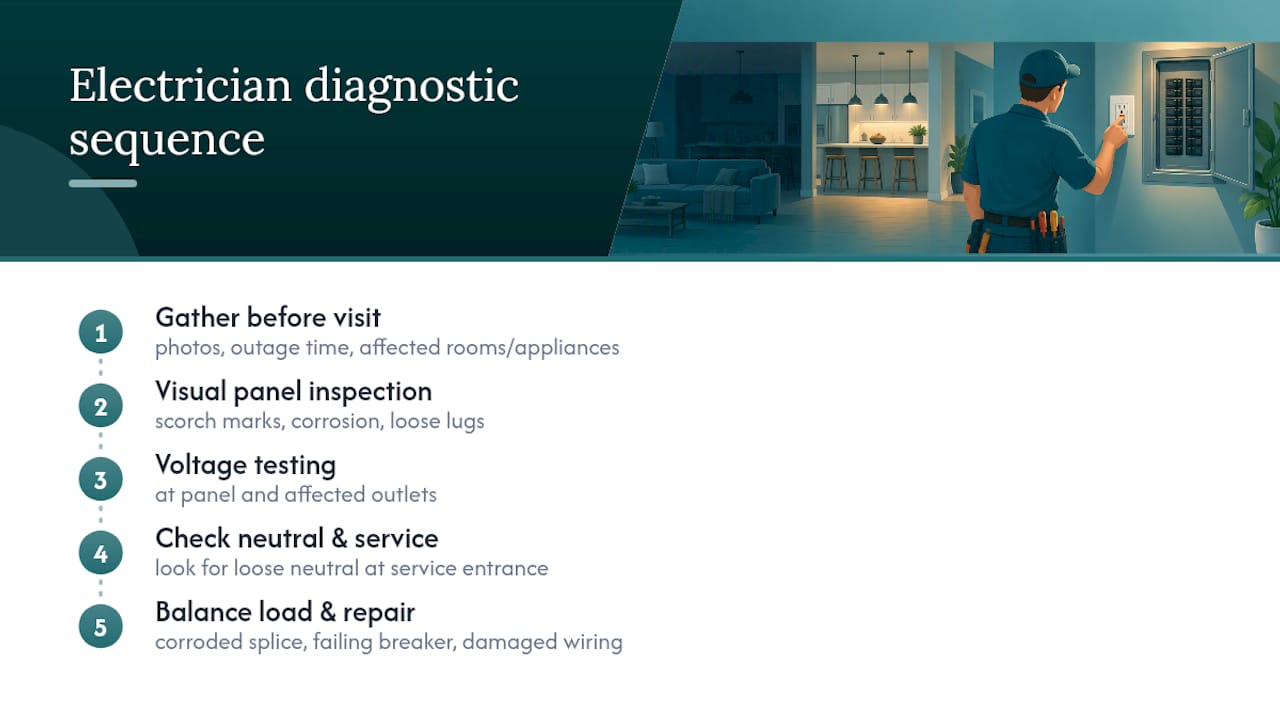
From there, load balancing across the two legs and targeted repairs, whether that's a corroded splice, a failing breaker, or damaged wiring, restore full function without a guess-and-check approach. Guardian Electrical Contractors handles this full range, from troubleshooting and repairs to panel upgrades, generator connections, and outlet or GFCI replacement.
Before a service visit, gather what you can: photos of the panel and any affected outlets, notes on when the outage started, and a rundown of which rooms or appliances lost power. That detail lets the electrician diagnose faster instead of starting from zero.
What Is Phase Loss and How Do Electricians Detect It?
Phase loss happens when one of the two 120 volt legs feeding your home stops delivering power while the other keeps working. It can originate at the utility transformer, at the service drop connecting your home to the pole, or at a failing connection inside your own panel or meter base.
The telltale sign is a house where roughly half the outlets and lights are dead while the rest work normally, often paired with 240 volt appliances like your dryer or oven acting oddly (running weak, humming, or not starting at all) since they need both legs simultaneously. Flickering or dimming lights on the working leg sometimes accompany phase loss too, as the remaining leg tries to carry uneven load.
Electricians detect phase loss with a voltage meter at the panel, testing each leg against the neutral bus bar to confirm which one has dropped. They'll also check the main breaker's lugs and the service entrance connections, since corrosion or a loosened lug at these points is a frequent culprit. This diagnosis is not a DIY job; testing a live panel without training risks serious shock, and misreading the results can send you chasing the wrong fix. If you suspect phase loss based on the symptom pattern, that's a same-day call to a licensed electrician, not a wait-and-see situation.
Can a Partial Outage Damage My Electronics or Data?
Yes, and this is the risk homeowners underestimate most. When power drops on one circuit and then returns, especially after a loose connection or a reset, the surge or irregular voltage that follows can damage anything still plugged in. Computers, routers, smart home hubs, and game consoles are particularly vulnerable because their internal components are sensitive to voltage swings that a lamp or toaster would never notice.
Beyond hardware damage, an abrupt loss of power to a computer or network-attached storage device risks corrupting files that were open or mid-save at the moment power dropped. A desktop that loses power without a proper shutdown can also suffer file system errors that surface days later, which is worse than an immediate crash because you don't connect the cause to the symptom.
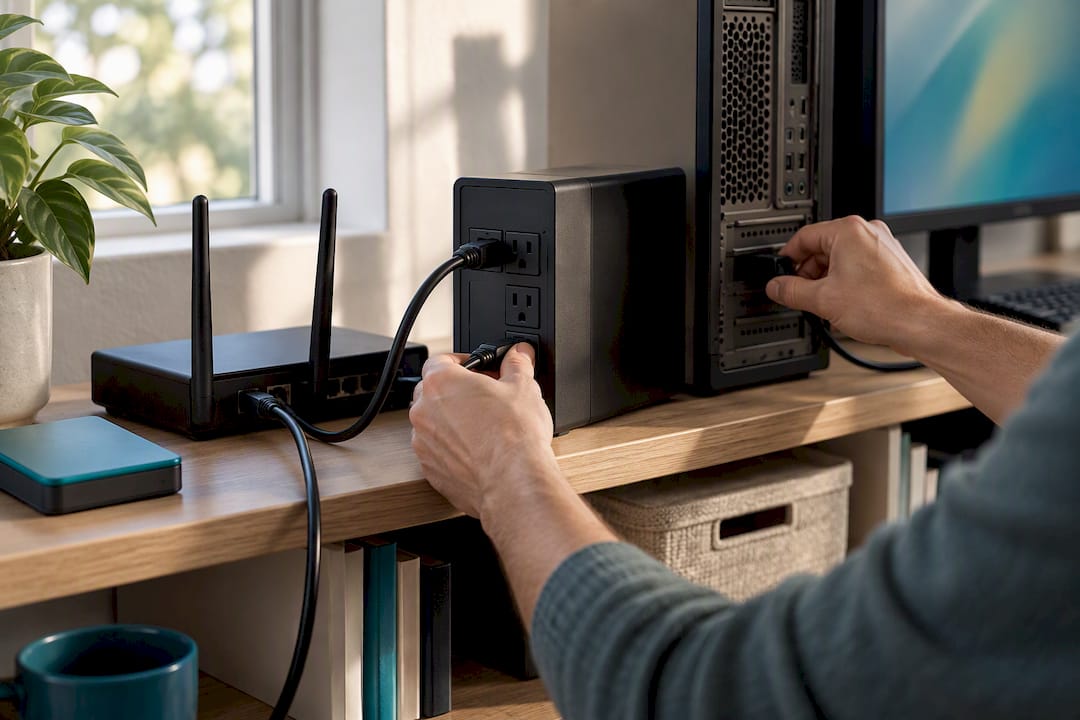
The fix is inexpensive and worth doing before your next outage, not after. A battery-backed uninterruptible power supply (UPS) for your router, computer, and any networked storage gives you a clean shutdown window instead of an abrupt cutoff, and it filters out minor voltage fluctuations that a basic power strip won't catch. For anything you can't afford to lose, cloud backup or an external drive that syncs automatically adds a second layer of protection that doesn't depend on your home's wiring at all. If partial outages are a recurring event in your house rather than a one-time fluke, that recurrence itself is a sign the underlying wiring issue needs a professional look, not just better backup habits.
What Upgrades Reduce the Risk of Partial Outages Long Term?
If your home experiences partial outages more than once every year or two, patching the symptom stops working and it's time to look at the system underneath.
An outdated panel, particularly anything using fuses or a brand no longer supported with replacement breakers, is a common root cause of recurring partial losses. Upgrading to a modern panel with adequate capacity for today's appliance load reduces the odds of overloaded circuits tripping breakers or overheating connections. Whole-house surge protection installed at the panel level guards every circuit in the home against voltage spikes from lightning strikes or grid switching events, which is a broader layer of protection than plugging individual devices into surge strips.
Rewiring older sections of a home, especially anything with aluminum wiring or connections older than 30 to 40 years, addresses the loose-connection risk at its source rather than waiting for the next failure. If you've added a lot of new electrical load over the years (a home office, an EV charger, a hot tub) without ever reassessing your panel's total capacity, that's often exactly where phase imbalance and overloaded circuits start showing up as partial outages.
These are not one-afternoon fixes, but they're also not guesswork. A licensed electrician can assess your panel's age, capacity, and wiring condition and tell you plainly whether an upgrade will actually solve the pattern you're seeing or whether the cause lies elsewhere.
How Should I Prepare for the Next Partial Outage?
A little preparation turns a stressful evening into a minor inconvenience. Keep a basic emergency kit ready year round: flashlights and batteries, a battery-powered or hand-crank radio, a portable phone charger, and a printed list of emergency numbers including your utility and your electrician.
For backup power, a portable generator with the correct heavy-duty cords covers essentials like a refrigerator or medical equipment during longer outages, but it needs a properly installed transfer switch to run safely, which is exactly the kind of connection Guardianhrsc's generator services handle. For shorter, more frequent partial outages tied to specific circuits, a UPS on your home office setup or entertainment center is a cheaper, simpler layer of protection that requires no installation beyond plugging it in.
Know your panel before you need it. Confirm your breakers are labeled accurately, keep a flashlight near the panel itself, and save your utility's outage-reporting number in your phone. During any outage, Ready to unplug sensitive electronics and check official outage maps before assuming the worst applies just as much to a partial loss as a full blackout.
Trust Your Instincts on Warning Signs
The advice most homeowners get is "just reset the breaker and see what happens." That's fine advice for a one-time trip. It's dangerous advice when repeated three or four times in a row, because each reset can mask a worsening short instead of fixing it.
What people underestimate is how often a "small" partial outage, one dead outlet, a flickering light, is the first visible symptom of a connection that's been degrading for months. The fix isn't paranoia over every flicker. It's knowing the three or four signs that separate a nuisance from a hazard, and treating those signs as a hard stop rather than something to try one more time.
Prioritize safety first, diagnosis second. Unplug your electronics, check your neighbors, then work through your GFCIs and breakers in that order. If anything trips twice or smells off, stop and make the call.
— Logan
Let Guardian Electrical Contractors Handle the Diagnosis
Homeowners can obtain access to licensed electrical professionals instead of troubleshooting breaker panels on their own. When a partial outage keeps coming back, a tripped breaker won't hold, or you're staring at scorch marks near an outlet, that's a job for trained hands, not another reset attempt.

Experienced technicians typically handle panel diagnostics and upgrades, GFCI and outlet repair, loose connection troubleshooting, and safe generator hookups with proper transfer switches. Their consultations work best when you come prepared. Snap photos of the affected outlets or panel, note when the outage started and which rooms it hit, and share that detail up front so the visit moves efficiently.
Every job follows licensed, code-compliant practices, because a partial outage caused by a wiring fault is not the place to cut corners. Ready to get it looked at? Visit Guardian's services page to request a consultation and get your powerfully restored, safely.
Sources
For real-time outage status, check your utility's own outage map first; most publish one online. Beyond your provider, the American Public Power Association tracks national outage causes and trends, Ready.gov publishes household preparedness guidance, and ESFI maintains detailed electrical safety warning signs. PG&E's help center offers a widely applicable troubleshooting sequence for partial outages regardless of which utility serves you.
- What Causes Electrical Outages? | American Public Power Association
- What do I do if only part of my home or business is without power? | PG&E help
- Ready
- Electrical warning signs | ESFI
FAQ
Why Am I Only Getting Partial Power?
Partial power almost always means a tripped breaker, a tripped GFCI outlet, or a loose wiring connection affecting one specific circuit or leg of your home's electrical system. It's rarely a utility-wide problem unless your neighbors report the same issue at the same time.
Can You Have Half a Power Outage?
Yes. Homes wired with two 120 volt supply legs can lose one leg while the other keeps working, which knocks out roughly half the outlets and lights while everything else runs normally. This pattern often points to a loose neutral or phase loss and calls for an electrician's inspection rather than a breaker reset.
Can You Have a Partial Blackout?
A partial blackout typically refers to the same thing as a partial power outage: specific circuits, rooms, or one leg of the home losing power while the rest stays on. It differs from a full blackout, where the entire property loses electricity at once.
What Is a Momentary Loss of Power Called?
A brief power interruption that resolves itself within seconds is usually called a "blink" or momentary outage, often caused by a utility protective device clearing a temporary fault like a tree branch touching a line. If the interruption lasts longer or repeats, it stops being momentary and warrants the same troubleshooting steps as any other partial outage.
Does Guardian Electrical Contractors Offer Emergency Diagnostics for Partial Outages?
Guardian Electrical Contractors provides troubleshooting, panel upgrades, and outlet or GFCI repair services for homeowners dealing with partial outages in the Myrtle Beach area. Current pricing and service details are available directly through Guardian's services page.