
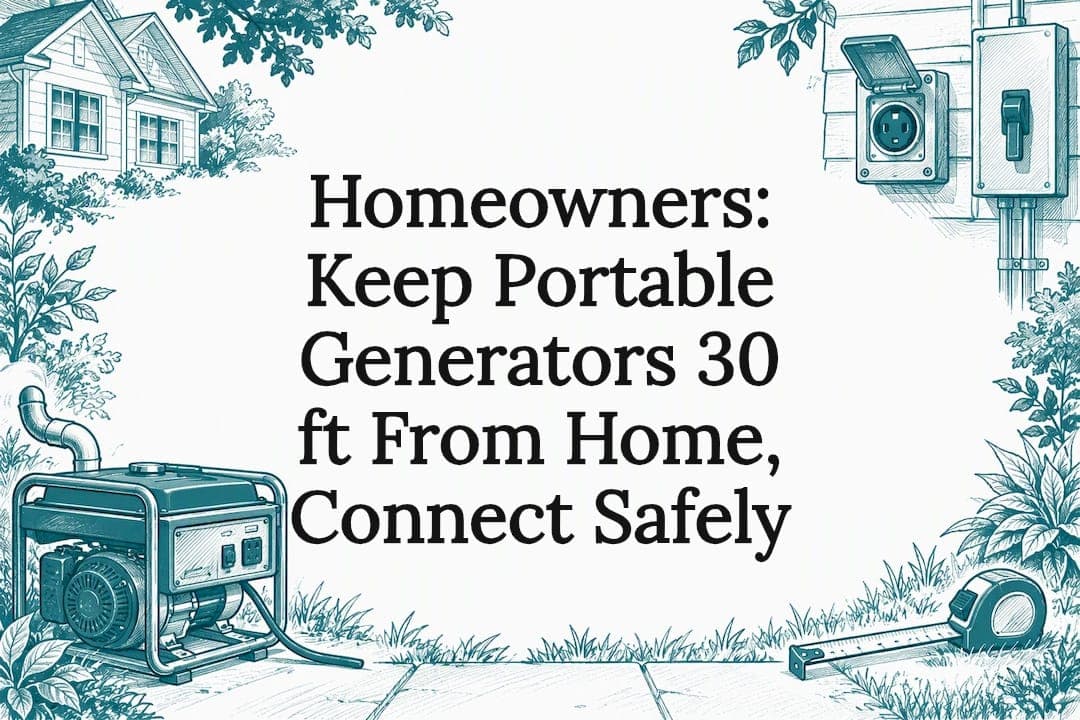
Use a transfer switch or an interlock kit, never a backfeed hack, and keep the generator well outside your home with the exhaust pointed away from windows and doors. These two connection methods are the only safe, code-compliant ways to send generator power into your home's wiring. If you plan to power specific circuits rather than run extension cords to individual appliances, call a licensed electrician to install the inlet box and switching equipment.
TL;DR:
- Using a transfer switch or interlock kit is essential for safe, code-compliant generator connection; never use a backfeed cord.
- Generators should always be placed at least 20 to 30 feet from the home with exhaust directed away from windows and vents to prevent carbon monoxide poisoning.
- For powering specific circuits, a transfer switch with a subpanel offers reliable, full-house control, while interlock kits are a lower-cost, flexible alternative for select circuits.
- Proper generator sizing relies on adding essential appliances' starting and running watts, with most portable units covering 3,000 to 8,500 watts.
- Routine monthly testing, correct fuel storage, and installation by licensed professionals are key to maintaining safe and reliable backup power.
Table of Contents
- Backfeed and carbon monoxide: what kills people and how to avoid it
- Safe connection options: extension cords, inlet boxes, and interlocks
- How to estimate generator size and prioritize circuits to avoid overload
- Where to place the generator for safety and proper ventilation
- Setting up, testing, and dividing the work between you and your electrician
- Permits, code compliance, and choosing a licensed electrician
- Routine maintenance and test schedule to keep your generator ready
- A contractor's view on the mistakes that cause the most problems
- How Guardian Electrical Contractors can help with your generator hookup
- FAQ
- Sources
Backfeed and carbon monoxide: what kills people and how to avoid it
Backfeeding happens when someone plugs a generator into a regular wall outlet using a cord with male plugs on both ends, pushing power backward through the house wiring and out to the utility grid. That reversed current can electrocute a line worker who believes the grid is dead while repairing an outage, and it can also overload your home's wiring since residential circuits are not built to carry a generator's output in that direction. The National Electric Code requires an isolation device, either a transfer switch or an interlock, specifically to prevent this kind of reverse flow.
Carbon monoxide is the other major killer tied to portable generators, and the numbers explain why placement rules exist. A CPSC report documents hundreds of generator-related carbon monoxide deaths in residential settings, with many incidents traced to units running too close to the house or inside enclosed spaces like garages.
Many people have died from generator-related carbon monoxide poisoning in their own homes, according to CPSC fatality data, and most of those deaths involved gasoline-fueled portable units.
A short list of rules prevents nearly every one of these deaths:
- Never run a generator inside a garage, basement, crawlspace, or on a porch, even with doors open.
- Never use a cord with two male ends or any other method to plug into a wall outlet.
- Install battery-backed carbon monoxide detectors on every level of your home before an outage happens.
- Keep the exhaust pointed away from windows, doors, and vents at all times.
If anyone in the house develops a headache, dizziness, nausea, or confusion while the generator runs, treat it as suspected CO exposure: get everyone outside into fresh air immediately, call 911, and do not go back inside until the home has been ventilated and checked.
Safe connection options: extension cords, inlet boxes, and interlocks
Your choice of connection method depends on how much of the house you need to power and how much you are willing to spend on installation. Three approaches cover most homeowner situations.
Extension cords directly to appliances work for the smallest setups, like running a refrigerator and a few lamps during a short outage. This method requires no electrical work, but it has real limits: cords must be heavy-gauge (12 or 10 AWG for most generator loads), rated for outdoor use, and kept as short as possible since longer runs cause voltage drop and heat buildup. You can only power what you can physically plug in, which rules out your furnace blower, well pump, or central air.
A power inlet box paired with a manual transfer switch or subpanel is the setup most electricians recommend for homeowners who want reliable, repeatable backup power. The inlet box gets mounted on the exterior of the house and wired to a transfer switch inside, which lets you select which circuits draw generator power while physically disconnecting them from the utility line. You connect the generator to the inlet using a twist-lock cord, which locks in place and will not vibrate loose the way a standard plug can. This method is fully NEC-compliant when installed correctly and lets you power an entire sub-panel of chosen circuits rather than juggling individual cords.
A breaker interlock kit is a mechanical device installed in your main panel that physically prevents the main utility breaker and the generator breaker from being switched on at the same time. Interlocks tend to cost less than a full transfer switch setup and give you access to any circuit in the panel rather than a preselected subset, but that flexibility comes with responsibility: you have to manually track which breakers you flip on and keep the total load under your generator's output. This Old House suggests posting a laminated list of safe breaker combinations next to the panel so nobody overloads the generator by accident.
A quick decision guide:
- If you only need to keep a fridge and a few lights running for a day, an extension cord setup is enough.
- If you want whole-house flexibility at a lower upfront cost and are comfortable managing breaker combinations yourself, an interlock kit fits.
- If you want the simplest day-to-day operation and are willing to preselect your essential circuits in advance, a transfer switch and subpanel is the better long-term investment.
Homeowners who want true whole-house coverage without touching a cord or switch during an outage sometimes upgrade to an automatic transfer switch paired with a permanently installed standby generator, which senses an outage and switches over on its own. That is a different category of equipment than a portable generator, and it is worth mentioning here only so you know the option exists if your needs outgrow a portable unit.
How to estimate generator size and prioritize circuits to avoid overload
Every appliance has two power numbers that matter: running watts, which is what it draws continuously, and starting watts, which is the brief surge needed to get a motor moving. A refrigerator might run at 150 watts but spike to 600 watts for a second when the compressor kicks on. A sump pump often runs around 800 watts but can demand 1,300 to 2,200 starting watts. A furnace blower motor and a window air conditioner follow similar patterns, with starting loads sometimes three to five times higher than running loads.
A simple worksheet approach works well:
- List every circuit or appliance you consider essential, such as the refrigerator, sump pump, furnace blower, and a few lights.
- Write down the running watts and starting watts for each item, found on the appliance label or owner's manual.
- Add the running watts together, then add the single highest starting watt figure on top of that total, since starting surges rarely overlap.
- Build in a margin above that combined number rather than buying a generator sized to the bare minimum.
That worksheet total tells you which generator class you need. A small 3,000 to 5,000 watt unit covers a refrigerator, sump pump, and some lighting. A 7,000 to 9,000 watt generator extends that to a furnace blower and window air conditioner. Beyond 10,000 watts, you are approaching the upper range of what a portable unit reasonably handles, and a standby system may serve you better if you need true whole-house coverage. Consumer Reports notes that most portable generators fall somewhere between 3,000 and 8,500 watts.
Pro Tip: If you run sensitive electronics like laptops, medical equipment, or smart TVs, choose an inverter generator, which produces cleaner, more stable power than a conventional portable unit.
A portable generator was never meant to replicate full household electrical demand, and trying to stretch one across central air, an electric water heater, and every outlet in the house usually just trips the breaker or stalls the engine. Pick your essentials deliberately instead of guessing.

Where to place the generator for safety and proper ventilation
Placement is not a minor detail, it is the difference between a safe setup and a fatal one. NIST and CDC modeling found that positioning a generator just 15 feet from an open window may not be enough to keep carbon monoxide from entering a home, particularly in two-story houses where exhaust can drift upward and back toward upper windows.
Generators placed 30 feet from the house with exhaust pointed away showed far lower indoor carbon monoxide entry than those placed closer or aimed toward the structure, according to NIST Phase II modeling, which recorded CO levels at the home's exterior dropping to a fraction of what pointing the exhaust toward the house produced.

Wind and house shape change how exhaust moves, which is why a single fixed distance does not guarantee safety in every situation. A generator placed in a corner or near a recessed entryway can trap exhaust in a pocket of still air even at a reasonable distance, so avoid those spots regardless of how far away the unit sits.
A short site checklist before you start the generator:
- Place it on a stable, level, dry surface at least 20 feet from the house, per Red Cross guidance, and farther when your layout allows it.
- Point the exhaust away from windows, doors, and vents, not just away from the nearest wall.
- Never run it on a porch, deck, breezeway, or inside an attached garage, even with the garage door open.
- Keep it visible or secured against theft without sacrificing the clearance distance, and avoid wrapping it in anything that blocks airflow for noise reduction.
Setting up, testing, and dividing the work between you and your electrician
Getting a portable generator ready for an outage involves a mix of tasks you can handle yourself and work that belongs to a licensed professional. Breaking it into stages keeps the project manageable.
- Inventory your essential loads using the worksheet method described earlier, and decide which circuits actually need backup power.
- If you are only running appliances directly off the generator, buy properly rated outdoor extension cords in the correct gauge for your loads.
- If you want a panel-level connection, contact a licensed electrician to install the exterior inlet box and either a transfer switch, subpanel, or interlock kit, and to pull any required permit.
- Once installed, have the electrician walk you through the exact startup sequence: start the generator outdoors first, let it stabilize, then connect the cord to the inlet before switching over circuits one at a time.
- Test the full system before you actually need it, confirming each prioritized circuit receives power without tripping the generator's breaker.
- Check that carbon monoxide detectors are installed and functioning throughout the house as part of your test run, not as an afterthought during a real outage.
The dividing line is straightforward: anything involving the main panel, new wiring, or a permanent inlet connection is electrician work, while cord selection, load planning, and routine testing are tasks you can manage on your own once the system is in place.
Permits, code compliance, and choosing a licensed electrician
Panel-level generator connections fall under the National Electric Code's isolation requirements, and most jurisdictions require a permit and inspection before the connection is considered legal to use. Skipping that step is not just a technicality: a failed inspection or an uninspected DIY panel connection can void your homeowner's insurance coverage if something goes wrong later, on top of the safety risk of incorrect wiring sitting behind your panel cover.
When vetting an electrician for this kind of work, ask a few direct questions:
- Are you licensed and insured in my state, and can you provide proof?
- Will you handle the permit application and schedule the required inspection?
- Can you walk me through exactly which circuits will be on the transfer switch or interlock before work starts?
Pro Tip: Ask for a written estimate that separates the inlet box, the switching equipment, and labor, so you can see exactly what you are paying for before work begins.
Timelines for this kind of job typically run from a single day for an interlock kit to a few days for a transfer switch and subpanel, depending on permit turnaround in your area.
Routine maintenance and test schedule to keep your generator ready
A generator that sat untouched since last winter is not a generator you can count on during the next outage. Run it monthly, under an actual load, for 15 to 30 minutes, and use that time to check for fuel or oil leaks and confirm the exhaust is still routed safely away from the house. Test your carbon monoxide detectors at the same time so the whole safety chain gets verified together, not just the engine.
Fuel storage matters as much as the engine itself:
- Use a fuel stabilizer in stored gasoline to prevent it from degrading between uses.
- Check oil levels before every start and change it according to the manufacturer's schedule.
- Keep the battery charged if your model uses electric start, and store the unit somewhere temperature-stable when possible.
- Schedule a professional service check annually, and keep a simple log of test dates and any maintenance performed.
A contractor's view on the mistakes that cause the most problems
The failures we see most often with portable generator setups are not exotic: generators placed too close to the house because the cord was too short, undersized extension cords that overheat under load, and homeowners who skip the permit step and end up with an interlock installed incorrectly. A short consultation before you buy equipment, ideally with photos of your panel and the spot where you plan to place the generator, catches most of these problems before they become expensive or dangerous.
— Logan
How Guardian Electrical Contractors can help with your generator hookup
We install generator electrical connections across Myrtle Beach, South Carolina, including transfer switches, interlock kits, and the panel work that goes with either option. If your project also touches your electrical panel capacity or you are weighing an upgrade alongside the generator hookup, our panels and upgrades work pairs naturally with this kind of job.

When you hire us for a generator connection, you get:
- An electrician who handles the inlet box, transfer device, and wiring to code.
- Permit filing and inspection scheduling handled on your behalf.
- A post-install test run so you know the system works before you ever need it in an outage.
- A consultation where you can share photos of your panel and planned generator location so we can plan the job accurately before we arrive.
If you want a transfer switch or interlock installed correctly the first time, request an estimate through our services page and we will schedule a consultation.
FAQ
What size portable generator do I need to run my entire house?
Running an entire house typically requires more than a portable generator can reasonably supply, since whole-home loads like central air and electric water heating push well past the 10,000-watt range. For most homes, a 7,000 to 9,000 watt portable generator covers essential circuits like the furnace blower, refrigerator, sump pump, and lighting rather than the full house.
Can you run a whole house off of a portable generator?
Not realistically for most homes, since a portable generator is sized to cover selected essential circuits rather than every outlet and appliance at once. A transfer switch or subpanel lets you choose which circuits get power, which is why prioritizing loads matters more than chasing whole-house coverage with a portable unit.
What size of a generator is needed to run a house?
The right size depends on which circuits you want to keep running, calculated by adding up running watts for your essentials plus the highest single starting watt figure among them. Most homeowners land somewhere between 3,000 and 8,500 watts depending on how many circuits they prioritize.
What is the cheapest way to hook up a generator to your house?
A breaker interlock kit is generally the lower-cost option compared to a full transfer switch and subpanel, since it uses your existing panel rather than adding new switching equipment. It still requires licensed installation to meet code and must never be substituted with a backfeed cord, which is dangerous and not a legitimate low-cost shortcut.
Sources
- Modeling the Effects of Outdoor Use of Portable Gasoline Powered Generator Exhaust Use on Indoor Time Course Carbon Monoxide Profiles (NIST/CDC Phase II)
- Generators and OEDT CO Poisoning Fatalities Report (CPSC)
- How to Use a Transfer Switch for Generators | Honda
- Generator Buying Guide - Consumer Reports
- Safe generator use | American Red Cross